SUMMARY

PROGRAM NOTE
Throughout his life, blues guitarist Orlando Underground harbored a secret interest in notated composition. A college degree was not a claim to fame in the world of rock and roll, at least not in those days, and so Orlando never told anyone about how during his college years he’d discovered and fallen in wild love with classical music. Those afternoons lying on the floor with a cup of black tea and Mahler. The Beethoven symphonies. His fascination with the sensation of order in certain pieces of music; the feeling that microscopic patterns in his own skin came to the surface by way of organized sound.
Orlando always wondered what life might have been like if he hadn’t stayed in the band all those years and instead had nurtured other musical interests. (Would things have turned out differently with Jess? This question, though seemingly unrelated, plagued him particularly. It had nearly killed him—and yet it was so undeniably musical—when she’d shrugged her shoulders and said, “I guess timing is everything, after all.”)
Orlando felt special affection for the patently nerdy idea of retrograde, that a thing moving backwards might be both recognizable and new. There was much more to backwards than Paul on Sgt. Pepper, if you allowed for abstraction in meaning, and some composers seemed to understand this. Orlando also held a fondness for certain numbers; five, especially, was mystical and mythical both. The five-syllable phrase how you broke my heart had followed Orlando for a seeming decade post-Jess, a relentless, five-pulse mantra that finally—in some kind of involuntary comedy—found new refrains, other words for the pulses; why won’t she come back becoming where’d I put my keys, or, please turn out the light. (Jess was the one who had teased him mercilessly for carrying around and reading Arnold Schoenberg’s Style and Idea, though she never told the guys in the band. It’s clear from the manuscripts that Orlando spent time exploring 12-tone rows and other methods associated with Schoenberg, and Jess laughed to see his scrawl in the margins of the music: Did I do this right? Arnold?) Echoes of Deep Purple’s Smoke on the Water pop up here and there throughout the Eight Lost Songs, in some instances nearing quotation, in others appearing as simple shapes, as lines re-cast, fragmented and transposed, perhaps underscoring the notion that at the heart of things lay the question of how we contend with wondering whether we’ve made the right choices in life, and whether we’ve gotten it right with the choices we have made. It’s likely that Orlando remained unaware of the reversal his position might be understood to represent, that in the classical music world there were growing numbers of composers who actively—if privately—yearned for and reached in the direction of rock and roll.
It was Jess who found the Eight Lost Songs in a desk drawer after Orlando died. She assumed that Orlando chose to write for clarinet in part because of Maya Ochoa, a dark-eyed clarinetist who lived on the fifth floor of his building in Brooklyn whom he and Jess saw often in the elevator and to whom, as far as Jess knew, he’d never spoken.
The Eight Lost Songs of Orlando Underground was commissioned by the Lark Quartet and premiered by them, along with Romie de Guise-Langlois, on Sept. 17, 2018 in Salt Lake City, Utah.
ABOUT ANNA
Playing the flute in the New Hampshire Youth Orchestra as a teenager was a formative experience for Anna Weesner, nourishing a love of music that started early with Suzuki method violin lessons at the age of five. Composition was a natural discovery in high school and college for the daughter of a fiction writer and a music teacher. Anna maintains a lifelong relationship with the radio and the presets in her car are heavy on pop.
Her recent output includes a set of songs called My Mother in Love, commissioned by Cygnus Ensemble for which she wrote music and text, and The Eight Lost Songs of Orlando Underground for clarinet quintet, commissioned and premiered by the Lark Quartet with Romie de Guise-Langlois. Winner of a 2019 Independence Foundation Grant, the 2018 Virgil Thomson Award in Vocal Music as well as an Academy Award from the American Academy of Arts and Letters, she is also the recipient of a 2009 Guggenheim Fellowship and a 2003 Pew Fellowship in the Arts. She has been in residence at MacDowell, the Virginia Center, Weekend of Chamber Music, Songfest, Seal Bay Festival, the Wellesley Composers Conference, and Civitella Ranieri. Her music has been performed widely, including by Cygnus Ensemble with Tony Arnold, the Daedalus Quartet, the Lark Quartet, the Cypress Quartet, the Cassatt Quartet, Prism Saxophone Quartet, Dolce Suono Ensemble, Peggy Pearson and Winsor Music, Counter)Induction, Dawn Upshaw and Richard Goode, Eighth Blackbird, Network for New Music, Orchestra 2001, the American Composers Orchestra and the Riverside Symphony, and has been featured at Tanglewood, the Look and Listen Festival, and the Portland Chamber Music Festival, among others. She studied at Yale (B.A.) and Cornell (D.M.A.) and is Professor of Music at the University of Pennsylvania.
PERFORMER’S NOTES
Caroline Stinson
I have been inspired and fascinated by Anna’s approach to writing in different “styles” since she first sent Lark the score to Orlando. In the 90’s we called it cross-ever, then it became “genre-bending”. Forget all of that! Anna created a fictional character to unleash her omnivorous and eclectic musical skills and tastes. She’s written a beautiful, imaginative, colorful and expressive work that explores all her own vessels of expression. She didn’t have to try on different costumes. Instead, she created a rock n’ roll alter-ego who longs to live in her classical world. And she uses a second Viennese school / Schoenberg 12-tone row to-boot.
Romie de Guise-Langlois
COMPOSER’S NOTES
The title of movement IV, A few questions for Arnold, is meant to evoke the idea that Orlando Underground was both fascinated and perplexed by Schoenberg’s techniques and music. This may be why this movement has some of the most explicitly pop-flavored music in it. A row is like a puzzle, and for someone who enjoys that, it offers fun and pleasure. (This may a quality that Orlando and I share.)

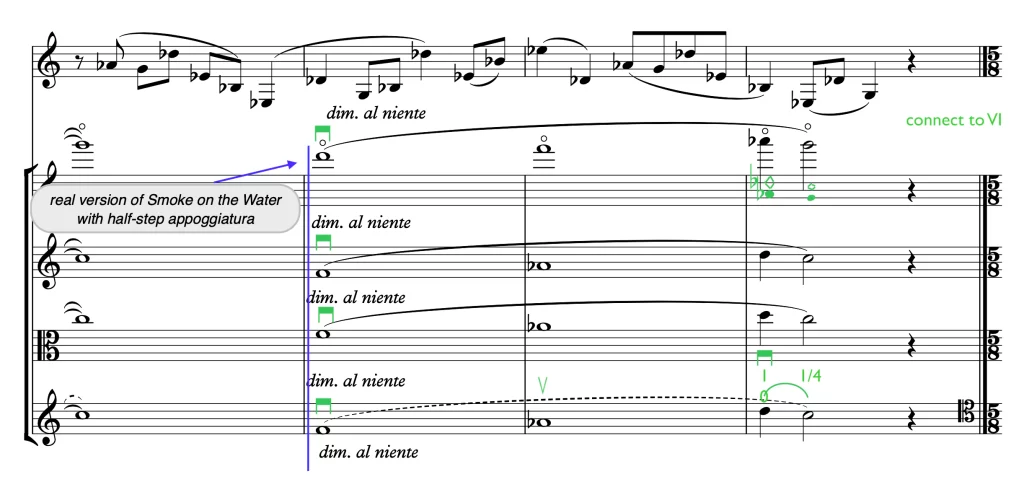
In “Orlando”, the row contains this basic appoggiatura shape that is associated with Smoke on the Water. It is inverted in the original row, and is abstract, but can be played with as an associated melodic motive.

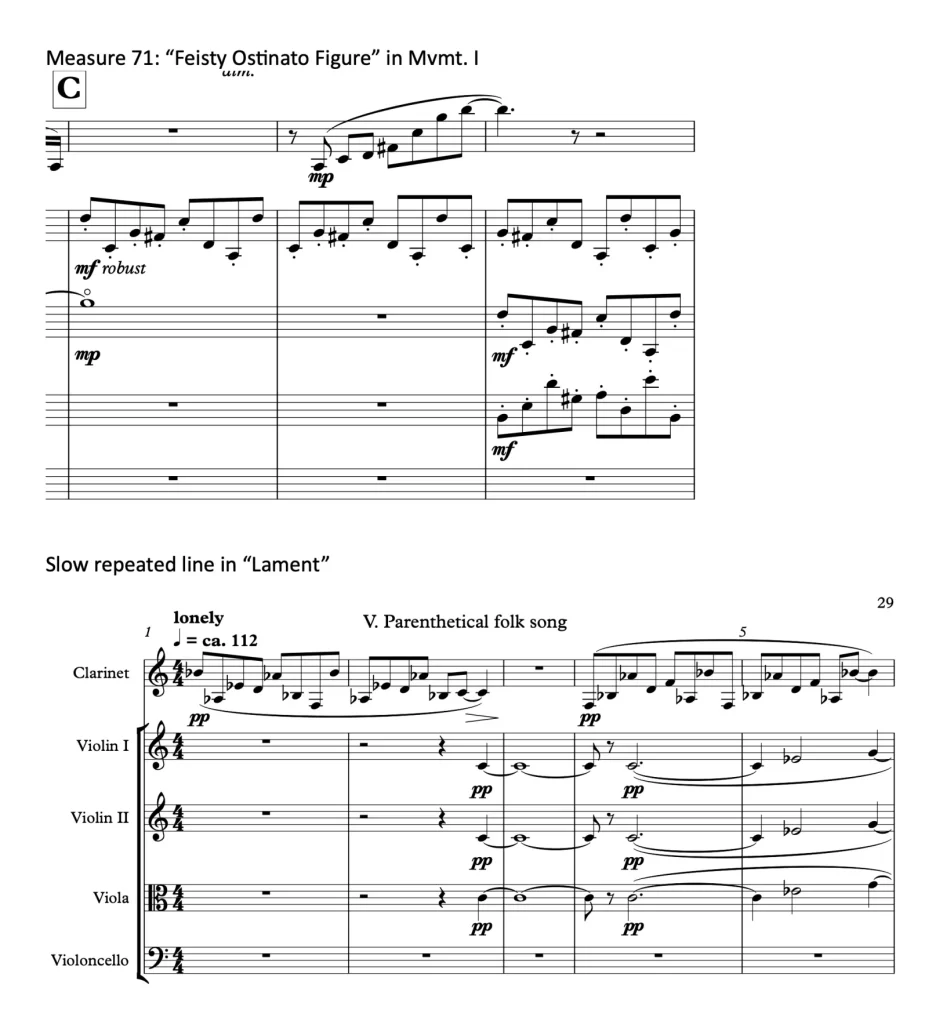
This is just one example of a kind of integrated approach to using these really different materials. Recasting lines for different purposes is an important technique—for example, the fact that the feisty ostinato figure at m. 71 in the first movement is the same as the slow, repeated line in Lament is a basic approach throughout the piece. In the case of the row, this same thing happens and with is sometimes combined with referential things, like the song Smoke on the Water, or the open strings of the guitar (Orlando’s main instrument).
ANNOTATED SCORE
Includes composer’s comments, analysis, some performance bowings and fingerings.
NOTE: This annotated score of for reference only. Performers may purchase the score, including the annotated version, from Subito Music.
RECORDING
Lark Quartet and Romie de Guise-Langlois, clarinet; Bridge Records (9524)
I. Early Days
II. Music in Five Pulses (how you broke my heart)
III. Parenthetical Blues (timing is everything)
IV. A Few Questions for Arnold
V. Parenthetical Folk Song
VI. Music in Five Pulses (how we used to dance)
VII. Lament
VIII. Oh, to Live in a World Symphonic